So, what is the easiest, most efficient way to make hot water?
The answer depends upon your needs, but you can pretty much eliminate the standard, tank-type water heaters you see in most homes. Common gas and electric tank-type units are legendary for their inefficiencies, many barely at 60%. That means a full 40% of your fuel costs are going up the flue stack, and over time, you’ll have wasted enough money to pay for an efficient water heater — but you won’t own one! And even if an inefficient, tank-type water heater is tolerable, or necessary, for simple domestic hot water, it’s highly impractical for heating a home or business.
On the other hand, if the combined needs of both your domestic hot water and space heating are less than 200,000 BTU’s, then a gas powered on-demand/tankless water heater can easily do the job.
Of course, if your home uses a combination of baseboard radiators and radiant floor tubing, a situation common to retrofit projects, a boiler may be your best bet. Boilers are designed to deliver lots of heat energy. They heat relatively small amounts of water to very high temperatures and vary in size from about 50,000 BTU’s to as high as you want to go.
Other water heating options include indoor and outdoor pellet or wood boilers, ground source heat pumps (sometimes called geothermal heating systems), and electric boilers (if electricity in your region is inexpensive).
Let’s start with one of the most powerful, efficient, compact, and versatile heat sources available, namely, the abovementioned on-demand/tankless water heaters.
And, not to boast (too much), but Radiant Floor Company pioneered the use of these water heaters for radiant floor heating nearly 25 years ago when many in the heating industry believed that: “Tankless water heaters don’t work for radiant heat”.
We not only disagreed, we proved them wrong.
The following are tankless water heaters that substantiate our claims. They are all designed for domestic hot water production, space heating, or both. All are “condensing” units, meaning, they are so efficient (96%), so capable of extracting as much energy as possible from the fuel source (natural gas or propane), that they “condense” that fuel down to water vapor. As a result, all these heaters use small PVC pipes to drain away this tiny trickle of water.
Navien
These on demand/tankless water heaters are manufactured with long lasting, durable, dual stainless steel heat exchangers. Quiet, compact, and wall-mounted, they vent with 2” PVC pipe for both intake and exhaust. Why is that important? Easy installation for one. Even more crucial, these so-called “direct vent” heaters use outside air for combustion instead of the precious inside air you’ve just spent energy to heat. In addition (and this is true of all on-demand units), the heater only makes hot water when you need it. There is no tank full of 125-degree water leaking warm BTUs into the surrounding air 24 hours a day, a condition called “standby loss”. That feature alone can save 10% on fuel costs.
Detailed information and specifications for these units can be found by following this link: https://www.navieninc.com/residential/tankless-water-heaters

Navien units are rated up to 96% efficiency.
A.O. SMITH / American Water Heater tankless / on-demand water heaters are a less expensive option, but still offer many excellent features. They’re extremely well engineered, also very quiet, compact (2.2 cu. ft. – great for small spaces), lightweight (60 lbs.), can mount conveniently on a wall, vent easily with PVC like the Navien, and have a well-deserved reputation for reliability and durability. A.O. Smith uses copper for their primary heat exchanger, stainless steel for the secondary. The heater plugs into a standard wall outlet and triggers when it senses flow – an open tap when heating domestic hot water, circulator pump(s) when heating the floor. A digital display indicates incoming and outgoing water temperatures, flow rate, flashes error codes for troubleshooting, and allows the user to set the unit for a variety of different temperature settings. Like all sophisticated on-demand heaters, the Takagi monitors incoming and outgoing water temperatures and modulates its burner up or down for maximum efficiency. Maintenance is simple – basically the fine-mesh inlet screen that should be checked periodically and kept clean.
Note: New installations may require a short period of daily cleaning until soldering flux and minor debris has been screened from the system.

On Demand Unit

American Water Heater (formerly Takagi) On Demand water heater
Electricity, if your rates are low (below .09 cents per KWH) can also effectively power an on-demand water heater. These units are very efficient (technically 100% because there is no flue stack exhausting even a tiny amount of waste BTU’s), but they often require a dedicated 100-200 Amp service panel. That can add considerably to installation costs.
Radiant Floor Company offers two electric on-demand water heaters – a line of Electro-Boilers for closed radiant systems, and various Rheem on-demand units for open radiant systems. Both heat small amounts of water to very high temperatures and are emphatically NOT tank-type electric water heaters. In fact, it could be argued that tank-type electric water heaters are the worst possible choice for radiant floor heating.
See our Heat Sources page for more detailed information.

Electric heating units heat water quickly but require more amperage/larger service panel.
That brings us to the other viable options for radiant floor heating and domestic hot water. These include gasification wood boilers, both indoor and outdoor varieties, that utilize cords of standard hardwood, a very powerful and renewable fuel source. And, of course, pellet boilers, an even more renewable fuel source (pelletized sawdust and scrap wood) that burns VERY cleanly and VERY efficiently and can easily provide for all domestic hot water and heating needs.
Then we have heat pumps, a water heating technology currently on the rise and worth considering. Especially if your heating needs are less extreme than, say, Vermont or Minnesota. Heat pumps have evolved way beyond the early models that barely worked during the semi-chilly so-called winters of my Arizona childhood. These modern residential units can extract usable heat from 40-degree (and much lower) air and provide plenty of hot water in the process.
But problems arise when temperatures fall well below freezing and heating demands climb. During those times, the heat pump water heater triggers its “back-up” heating elements to meet the demand, and, you guessed it, you’re then using expensive, high energy consuming resistant heating elements that are scarcely different than a standard tank-type electric water heater. We know how useless they are for radiant heating.
So, again, if you live in the lower latitudes of North America and your space heating needs are modest, a heat pump water heater may be worth considering.
As would solar energy. With fuel prices rising, even solar water heaters can contribute useful BTUs to our heating systems. I do that here in cloudy Vermont (as unlikely as that sounds). And solar evacuated tube water heaters are not only clean, efficient, and environmentally sound, they also deliver years of service long after they’ve paid for themselves.
Of course, only people in areas with reliable, daily sunshine (Arizona, Old or New Mexico, or Colorado, for example,) and a high R-value home with sufficient solar collectors could manage a totally solar powered heating system. But, my own brother did it in Arizona’s high desert at winter temperatures sometimes below 15-degrees F. Solar is indeed very powerful in the right location – and it pays for itself on its journey to becoming free.
Radiant Floor Company can design a solar system to meet your needs. See our Heating Water With Solar Energy pages for more information.
And finally, there’s ground source heat pumps, often called geothermal heating systems. These systems are more expensive and more complex than simple “mount on the wall on-demand water heaters”, but once installed, they tap a heat source as free, reliable, and bottomless as the cycles of Nature. For those with the resources, geothermal is well worth investigating.
Standard flat plate solar collectors

Flat Plate Solar Hot Water Panels Cutaway

Evacuated tube solar collectors

Tubes

Evacuated Tubes work great even in the winter
Bottom line: As long as the water flowing through the radiant tubing is a steady temperature between 120 and 135 degrees, the method of heating it is up to the homeowner.
Zoning
We’ve seen that virtually any method of heating water will work for radiant floors and that PEX tubing is the best heat transfer medium. So, how do we spread that heated fluid to the living space?
Although it’s perfectly okay for even a large area to be a single zone, sometimes people want to break a space into multiple zones. A zone is any area controlled by a single thermostat and supplied by a single circulating pump. A zone can be tiny or huge. A zone can consist of many circuits or loops of tubing, or can be a single circuit. Circuit lengths should not exceed 400′ of tubing (300′ for 1/2″ PEX), but a zone may contain any number of circuits.
So, the question becomes: How many zones do I need? The answer depends upon your lifestyle, the size of your heated space, and the unique architectural characteristics of the building. As a rule, keep zoning to a minimum. There’s nothing wrong with treating an entire floor as one zone. By one floor, we mean one elevation. Remember, the first and second story of one home shouldn’t share a single zone. So, if you have a two story house, your system will be a minimum of two zones.
Minimum zoning is important because radiant heating is very even. You are warming not only the floor, but also every object in the room. As a result, the entire space tends to equilibrate. Treating every room in the house as a separate zone is not only a waste of time and money, but it won’t give you much control over a space that tends to seek the same even temperature.
Zoning entire sections of a floor makes more sense. The most common (and effective) procedure to zone your Radiant heating system, is through a method of discerning “Daytime” and “Night-time” areas. A block of rarely used bedrooms could be on their own zone, for example. Also, many people prefer to maintain their master suite at a cooler temperature than the rest of the living space. If there’s a lifestyle reason to maintain one section of a given floor at a noticeably warmer or cooler temperature, then zoning is appropriate.
Another example would be architecture features like sun rooms or great rooms with lots of glass. These rooms have a heat signature unlike the rest of the living space. During the day, a sun room can be 20-degrees warmer than the living room. If the thermostat controlling the zone is located in the living room, the sun room will receive heat it doesn’t need. The reverse is also true. At night, the sun room will give off much of its heat due to its large amount of glass. Trying to keep the sun room warm during a cold winter night would overheat the rest of the living area if both spaces shared the same zone. Of course, it goes without saying that window shades greatly reduce nighttime heat loss in high glass areas and should be installed whenever possible.
Adding a zone typically increases the cost from $600.00 to $800.00 depending on the application. These costs result with the addition of a manifold, Pump, Thermostat/Floor sensor, relay, fittings and valves, etc. These varied costs are dictated by the volume of each additional zone. The cost savings of additional zones are realized through comfort, control and energy savings due to the unnecessary overheating in a given area.
A garage would always be on its own zone. (return to top)
Multiple Circuits
So, if a zone can be any size, and each zone uses only one circulating pump, how far can the hot water travel before it looses all its heat?
The answer depends upon the size of the tubing used. The smaller 1/2″ PEX is limited to a 300 ft. run, the 7/8″ PEX to about 400 ft. So, if a zone is large enough to require more than, say, 400 ft. of PEX, the heated area must be broken up into multiple circuits, all approximately the same length. Similar lengths are important because you never want to give the water a path of least resistance to follow. If your zone consisted of three circuits, one 200 ft. long, and two 100 ft. long, the two shorter circuits would steal the water from the longer 200 ft. circuit because they would offer the pump less resistance. An inefficient heating system would result.
This is how it should be done. Let’s say that your entire first floor is one evenly heated space, one zone. You need 1200 ft. of 7/8″ PEX tubing, spaced 16″ on center, to cover the whole area. If you tried to run the hot water continuously through 1200 ft. of tubing, you’d end up with ice water by the time you got back to your heat source.
Instead, you can break up the zone into one of these configurations:
(6) 200 ft. circuits
(4) 300 ft. circuits
(3) 400 ft. circuits
You can see that none of the circuit lengths has exceeded 400 ft. In each case, the water is returning to the heat source before or at the 400 ft. point.
Keep in mind also that these circuit lengths are just examples. A circuit length should conform to each individual situation. The installer can be flexible within the above guidelines. If you are installing tubing in your floor joists, and you determine that the ideal circuit length for your situation would work out well as (5) 240 ft circuits… then by all means do it that way. (see The Floor Joist Installation for detailed installation instructions) (return to top)
The Zone Manifold
A tank of efficiently heated water won’t do much heating unless it can be distributed effectively to the zones. For this we use a Zone Manifold. This is simply a factory built manifold containing all the gauges, valves, pump flanges, etc. necessary to mount multiple circulating pumps in one central location. It’s normally installed very near the heat source so that any pump, when activated by a signal from the zone, can draw hot water and send it to the floor.
If for some reason, the Zone Manifold must be located more than six feet (three feet for on-demand units) from the heat source, the pipe size between heat source and manifold should be increased in direct proportion to the distance. Contact one of our technicians for specifics and never use any piping material except copper to connect the heater to the Zone Manifold, i.e. never use PEX, PVC, ABS, black iron, or garden hose for this purpose.
A heating system’s supply and return pipe size is dictated by the total volume (all zones combined) in a system. We recommend copper tubing for both the supply and return from the heat source to the Zone manifold and back to the heat source, to minimize constriction of the (much needed) volume to the zone manifold. Constricting volume to and from the zone manifold may create “in fighting” from competing pumps as they may struggle for volume, denied via smaller (undersized) piping.
Every zone always has its own circulating pump. That way, the pump can be sized to match the amount of tubing in the zone. The fluid from the pump then enters the supply line to the zone, travels through the floor, then returns to the heat source. (return to top)
Supply and Return Lines
The Supply Line
In a floor joist installation, a supply header feeds the circuits within a zone. This header is simply a 3/4″ copper supply pipe that comes from the circulating pump. (See The Floor Joist Installation for detailed information on building the supply header.)
In a slab installation, the supply line is run to one side of a slab manifold (see photo below) that has already been installed as part of the slab pour. (See The Slab Installation for detailed information on installing the slab manifold.)
The Return Line
Every circuit of tubing will have a beginning (supply) and an end (return). After traveling the entire length of the circuit, the fluid flows into a return pipe, also 3/4″ copper. This return pipe leads back to the heat source where the water is re-heated and sent back to the supply side of the circuit. This cycle repeats until enough heat has entered the space to be warmed. Only when the thermostat in the zone has been satisfied will the zone pump shut off. (return to top)
Using Adaptors and Couplings
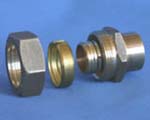
Adaptor
Adaptors
Normally, all supply and return lines are insulated with foam pipe insulation or fiberglass. This is to prevent heat loss as the water travels to and from the heated floor. Most of the time, supply and return lines are made of 3/4″ copper pipe. This is because you are already in copper pipe mode when you leave the circulator pump. Getting from copper pipe mode to plastic tubing mode requires a brass fitting called an adaptor.
Adaptors are very handy fittings. The ability to convert from copper to plastic, and back, at any time, gives the installer a great deal of flexibility when it comes to running supply and return lines. Even while threading the radiant tubing through floor joists, adaptors can be used to overcome obstacles in the joist bays, make super tight bends, etc.
Couplings
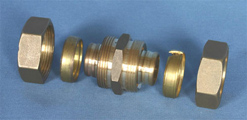
Coupling
Whenever the installer needs to connect plastic to plastic, use a coupling. Badly kinked, punctured, or crushed tubing can be easily repaired using couplings. Like adaptors, couplings are brass fittings.
See Connecting Adaptors and Couplings in the Installation Details section of this site. (return to top)
The Slab Manifold
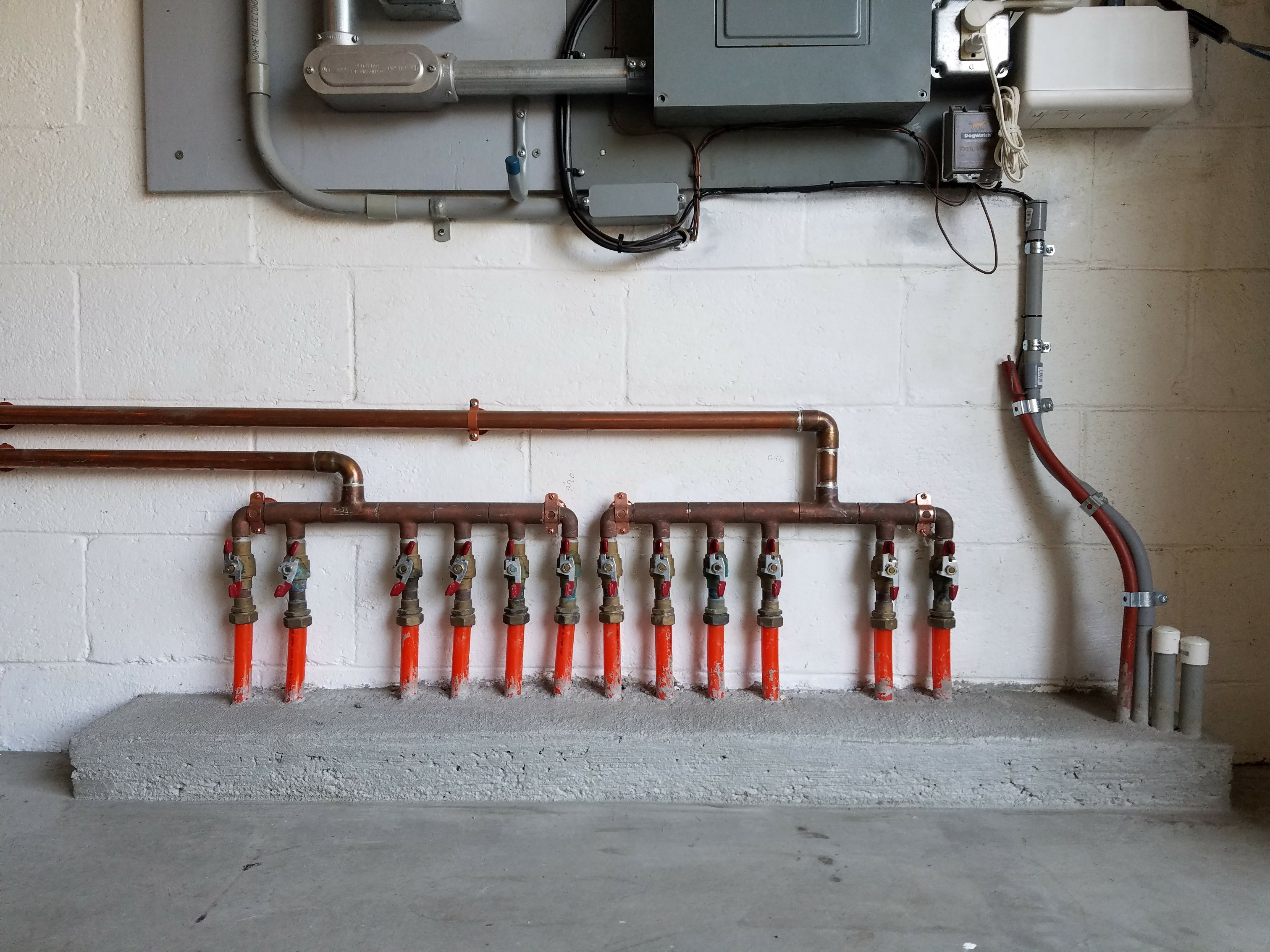
Whenever radiant tubing is poured into a concrete slab, a slab manifold should be used. More than merely a method of splitting a supply feed into two or more branch circuits, the slab manifold also doubles as a pressure test kit. Built into every manifold you’ll find a pressure gauge and an air stem. Once the tubing has been installed and all the connections have been tightened with a wrench, use the air stem and an air compressor to pressurize the system to 50 psi. If several hours pass without any significant drop in pressure, you can rest assured that your tubing is ready for the pour.
-

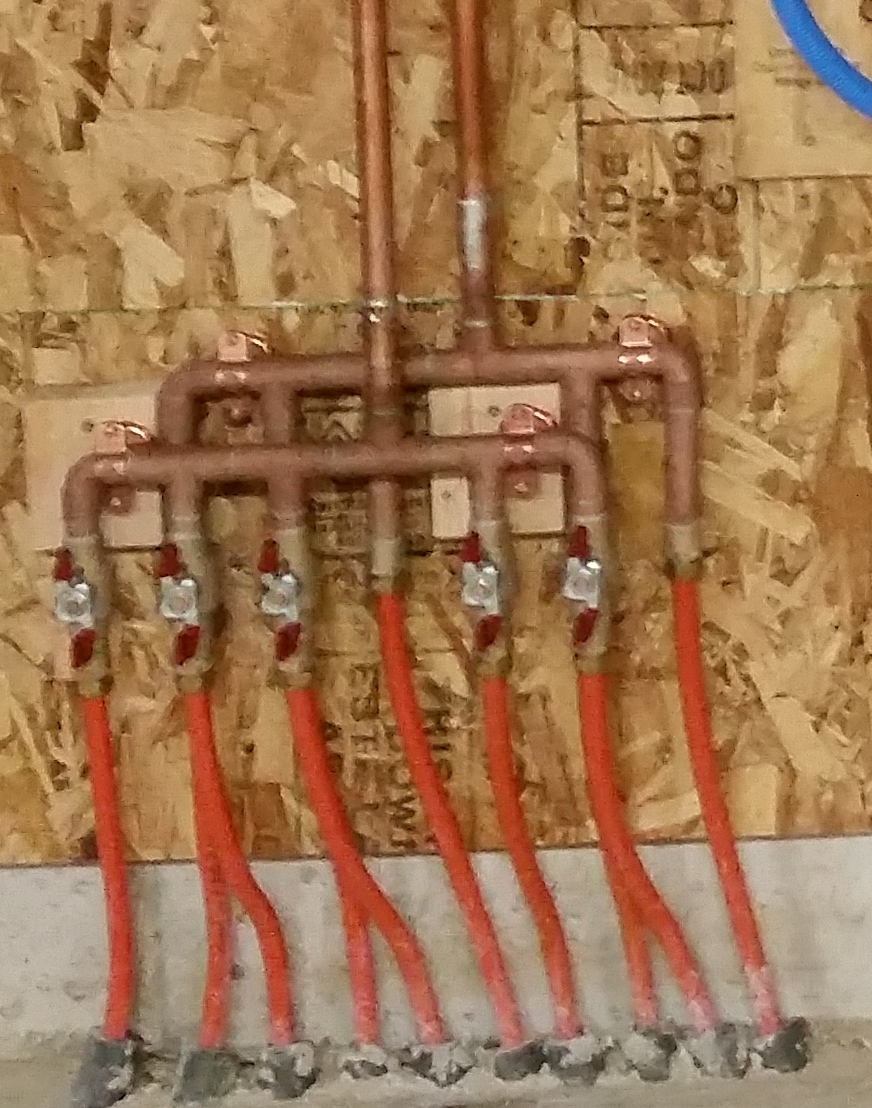
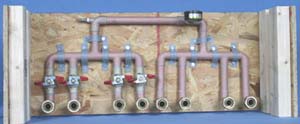
- Example of “Wall mount” loop manifold
-

- Loop manifold with alternating supply & return
-

- Notice that the supply side of the manifold is joined to the return side by the pressure testing assembly.
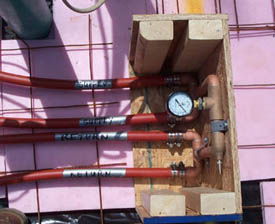
Slab manifold in box, ready for pour.
The manifold is also useful as a safety gauge during the pour itself. If at any time you question the integrity of the system, checking the pressure gauge will tell you instantly whether or not the tubing has been damaged.
The box used for shipping the slab manifold becomes the form to pour your concrete around. This prevents the concrete from coming into direct contact with the manifold and creates a “manifold well” in the slab to protect the tubing and connections from damage during later stages of construction. (Note: the photo shows the manifold box without the front panel installed.) (return to top)
We build our manifolds here in our factory. Each multiple Loop manifold includes ball valves for each pex circuit as this will also ensure better purging when filling the system. Equal pex lengths are the best way to ensure even balance and heating. The MOST accurate way to balance your system (with uneven lengths), is to measure the supply and return temperatures of each pex circuit. Shorter lengths will require more resistance so as to equalize flow when balancing with the longest length. The best way for properly equalized flow is equal circuit lengths.
We include (full-port) ball valves in our multiple circuit/loop, zone design. These valves are put in place for each pex circuit/loop in order to fill and purge separate lengths.
Some loop /circuit manifolds available today use Mechanical Flow meters, Balancing valves or Circuit setters. We don’t recommend them due to their stifling (flow sensing) design,… even at their “Wide Open” settings, resistance in these valves are apparent.
Mechanical Flow meters work by sensing flow via liquid movement and measures flow as the amount of fluid passing through the flow meter. This movement is metered through a resistance design, which inhibits flow and increases resistance/head pressure. Another disadvantage of mechanical type water flow meters for water measurement is that they may clog more easily when the liquid is dirty, contain particulates and create increased flow restriction etc. This can lead to increased maintenance issues. Mechanical water meters also do not work well when the water flow is low. The zone’s pump may not overcome this head pressure due to the resistance created by this resistance. There may (then) be a need to up-size the zone’s pump, OR the supply and return line’s size may be increased to lessen this (potential) issue. The pump size / model for each zone is dictated by the zone’s volume and supply and return piping,…This is based on using 3/4″ copper for zones with multiple circuits larger zones volume may require 1″ supply and return, again total zone volume will dictate this requirement. Each type of flow-meter has its own specific applications and installation constraints. There is no “one size fits all” flow-meter.
Our findings support the a-fore stated information and is based on years of shop and field experience as well as customer feed back through diagnosed troubleshooting.
Mounting the Mechanical Components
Zone Manifold
Zone Manifold
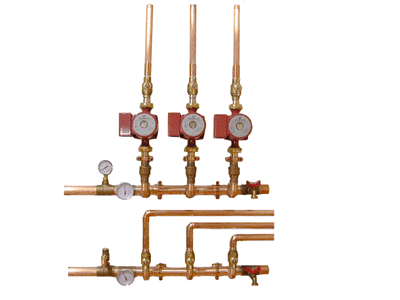
The zone manifold is divided into two sections…supply side and return side. Both sections should be mounted fairly close to the heat source. In multiple zone systems containing many pumps, the supply side of the manifold can be quite heavy so care should be taken to mount it securely. When you receive your manifold, you’ll notice that we’ve included a piece of plywood. The plywood should be removed and mounted on the wall next to your heat source. This will provide a secure foundation for both sides of your manifold and give you a board already precut to the width of your particular manifold.
Also note the “test caps” soldered onto the ends of the zone manifolds & the Expansion and Purge Kit. We install these for pressure testing purposes and to prevent debris from entering the manifold during shipping. These caps should be removed before plumbing the manifold.
In the bag of mounting hardware included with your order you will find two excellent mounting assemblies: 1) 1 1/4″ bell connectors, and 2) split ring hangers, complete with precut all-thread rods and the cast iron plate that the all-thread screws into.
The bell connectors are mounted to the plywood and attach to the main body of the manifold.
The split ring hangers are also mounted to the plywood, of course, but they attach to the 3/4″ copper pipe just below the circulating pump. The piece of all-thread is used to bridge the gap between the plywood and the split ring hanger and provide a strong support.
You’ll also notice identical brass tee fittings on each end of the zone manifold.
The outlet of the tee is threaded. Depending on how you decide to orient the manifold in relation to your heat source, this threaded outlet will contain either a drain valve or an in-line thermometer.
Obviously, you’ll want to install one of the in-line thermometers at a point where the hot water first enters the supply side of the manifold. This way you can monitor the fluid temperature on its way to the floor. The second in-line thermometer is installed so that you can monitor the temperature of the water as it leaves the return side of the manifold and travels back to the heat source.
Install the two drain valves in the tees opposite your in-line thermometers. These valves are provided as a means of draining the radiant system should that ever become necessary.
Circulating Pumps
-

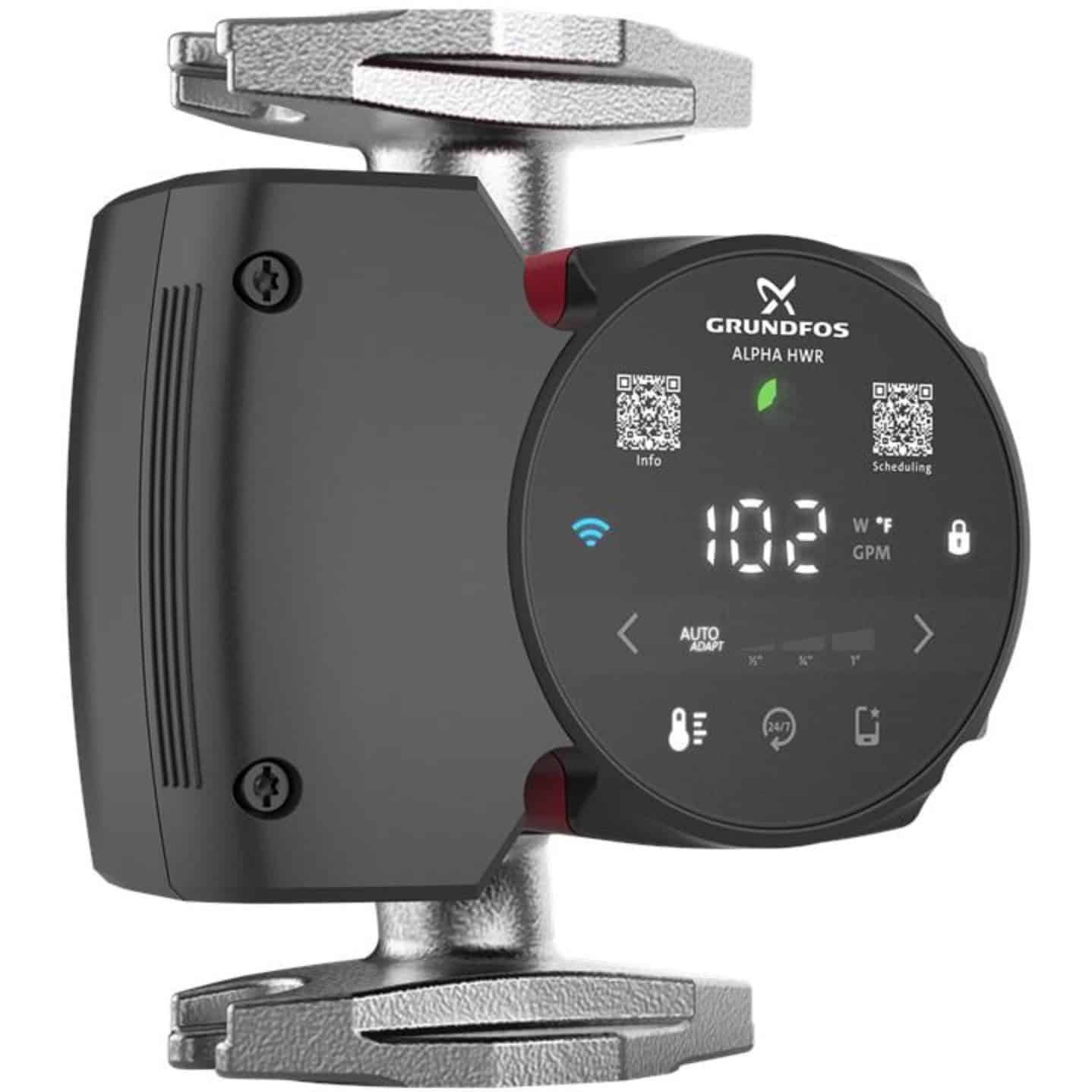
- Grundfos Alpha pump boasts 50-75% efficiency
-

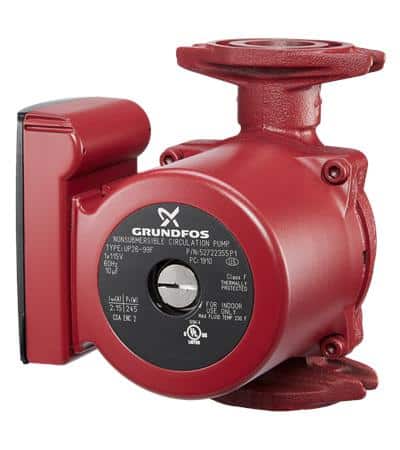
- A conventional, high-quality radiant circulating pump manufactured by Grundfos
-

- Grundfos stainless/potable union style pump
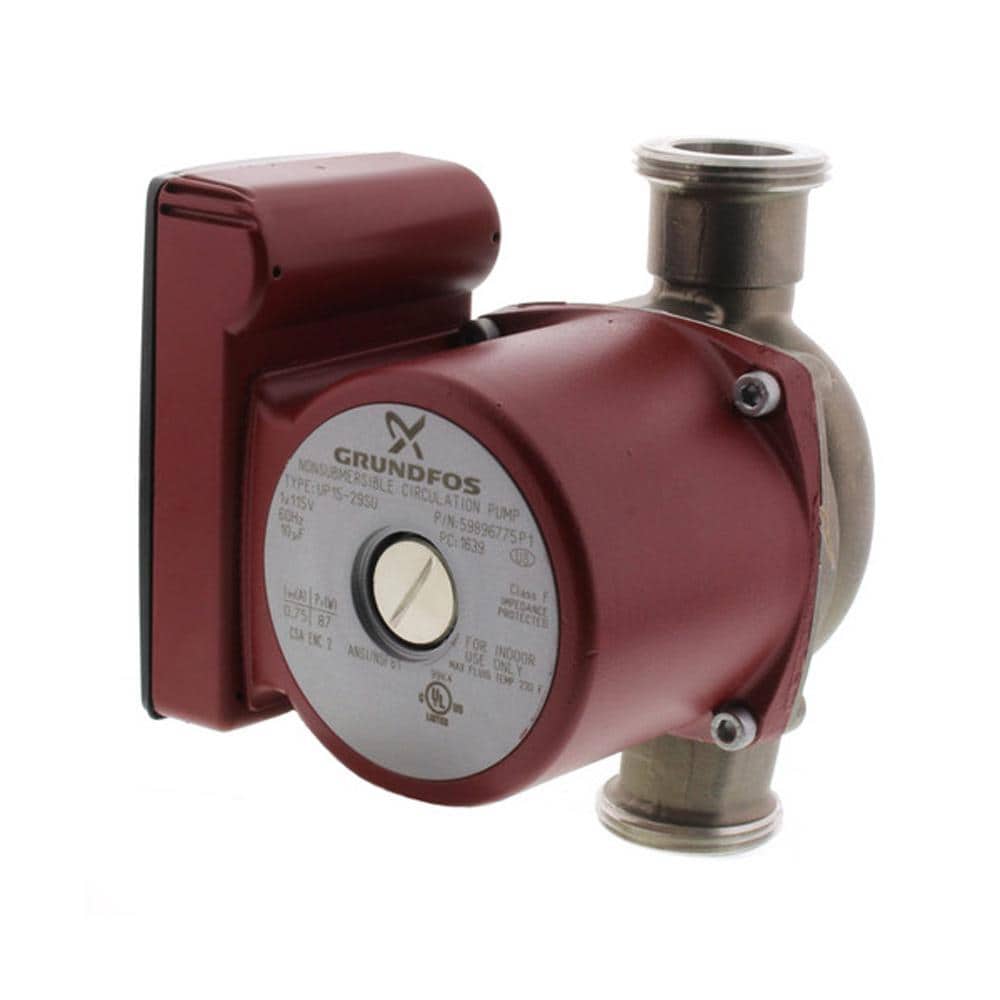
Once the zone manifold is mounted, the circulating pumps are very easy to install. The pump flanges are built into the manifold so attaching the pump is simply a matter of aligning the pump with the flange and bolting it in.
For single zone systems (i.e. one pump) always orient the circulating pump so that the arrow on the body of the pump is pointing upward. This way any air rising in the system is pushed up and away from the pump. Note: Radiant Floor Company has designed what we call “Radiant Ready” system. These are pre-plumbed and pre-wired single-zone plumbing assemblies mounted on a plywood board. Depending upon which package is needed, i.e. for an “open” or a “closed” system, only four or five solder connections are needed to complete the mechanical part of the radiant system.
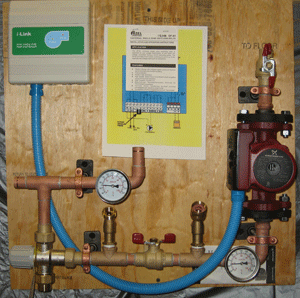
Radiant Ready “J”, a single zone system for use with an existing boiler.
For multiple zone systems, you’ll want to pre-wire the pumps with 14 gauge wire before you install them into the Zone Manifold. Follow your local codes for specific wiring guidance. Some codes require flexible conduit from the relay box to the pumps, others allow a simple Romex connection.
Pump Controller

Pump Controller Box
The pump controller box is usually mounted fairly close to the rest of the mechanical components. However, some people choose to locate it some distance away. The controller displays a green light to indicate power to the system and red lights to indicate which zone or zones are currently operating. It can be a very handy way of monitoring your system and you may want to install it in some location that you frequent often. Radiant systems are silent. If you’re like me and are curious about the rhythms of your system, you’ll want your controller somewhere that you can conveniently see it.
Wiring the controller box is generally very simple and schematics are included with every system. But, if you have questions, just contact one of our technicians and they’ll happily walk you through the process.
Expansion and Purge Kit
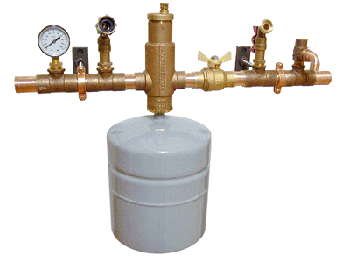
For Closed and Heat Exchanger systems, you’ll need the Expansion and Purge Kit (EPK). This consists of an expansion tank, an air eliminator, fill and drain valves, a pressure gauge and a pressure relieve valve. The EPK is pretty much factory assembled. You’ll have to screw the expansion tank into the bottom of the air eliminator because the tank is shipped in a separate box, but that is a simple operation.
The EPK makes it very easy to fill and simultaneously purge air from your newly installed tubing, and the expansion tank component acts as a sort of “shock absorber” in a closed system. When water heats up, it expands. The flexible membrane in the tank absorbs that expansion.
In addition, the pressure gauge in the EPK helps you charge the system with the proper 15-20 PSI, and during the life of the system, lets you know when more fluid needs to be added by indicating a pressure drop below 10 PSI.
The pressure relief valve is a safety device very much like the pressure and temperature relief valve on your water heater. It protects the tubing from excessive pressure.
Mounting the EPK is similar to mounting the zone manifold. Use split ring connectors and all-thread to secure the EPK to a wall next to your heat source. In Closed and Heat Exchanger systems the EPK is installed between the heat source and the zone manifold, so that the plumbing itself offers a great deal of support to the assembly. Always install the expansion tank after the EPK has been mounted. (return to top)
A world of Possibilities
One of our customers, CAD Master Dan Willis of Grants Pass, Oregon sent us this schematic of a system we designed for him utilizing solar and wood, with propane for back-up.
It illustrates a basic fact: Whether you’re heating a single small zone with a standard, tank-type water heater, or, as in Dan’s case, blending multiple heat sources into a harmonious, multi-layered system, Radiant Floor Company can help.
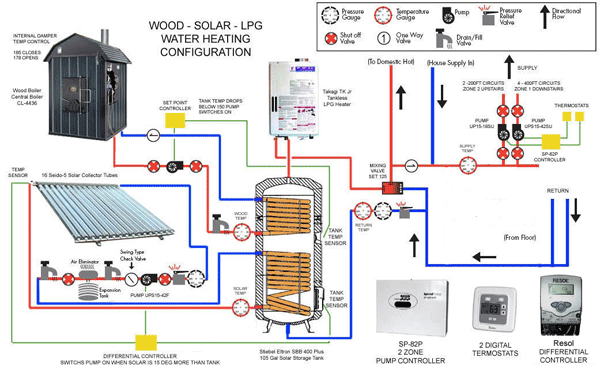
Solar Wood Hybrid Radiant Heat System Schematic